Troubleshooting · 9 min read · June 26, 2026
Mold vs. Yeast Strands: How to Tell If Your Kombucha SCOBY Is Actually Ruined
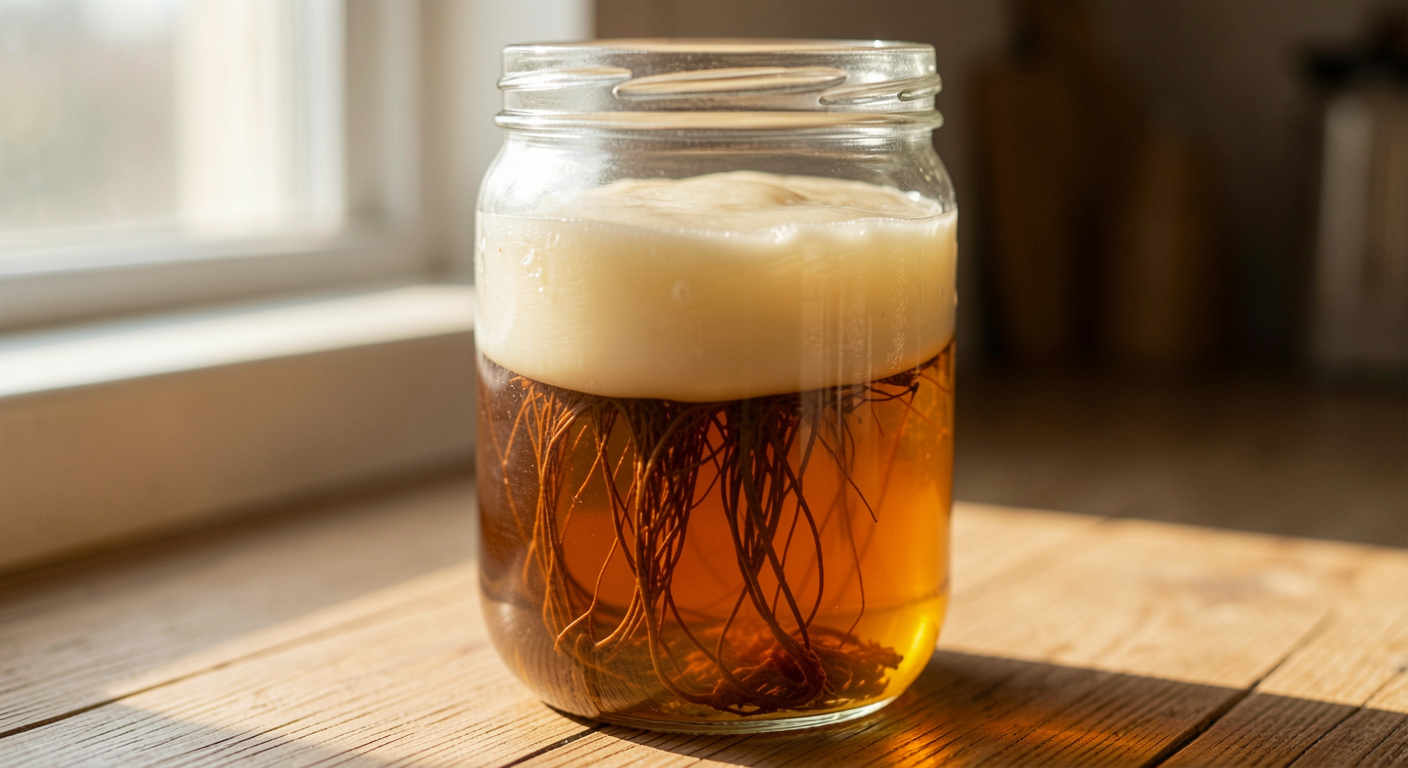
One of the most heart-sinking moments in home brewing is peering into your fermentation vessel and seeing something alarming on the SCOBY's surface — but before you pour everything down the drain, you need to know the cardinal rule: if it's below the liquid surface, it is almost certainly yeast, not mold. Distinguishing between benign brown yeast strands and genuine fungal contamination comes down to three things: location, texture, and color — and getting it right can save your batch, your SCOBY, and weeks of work.
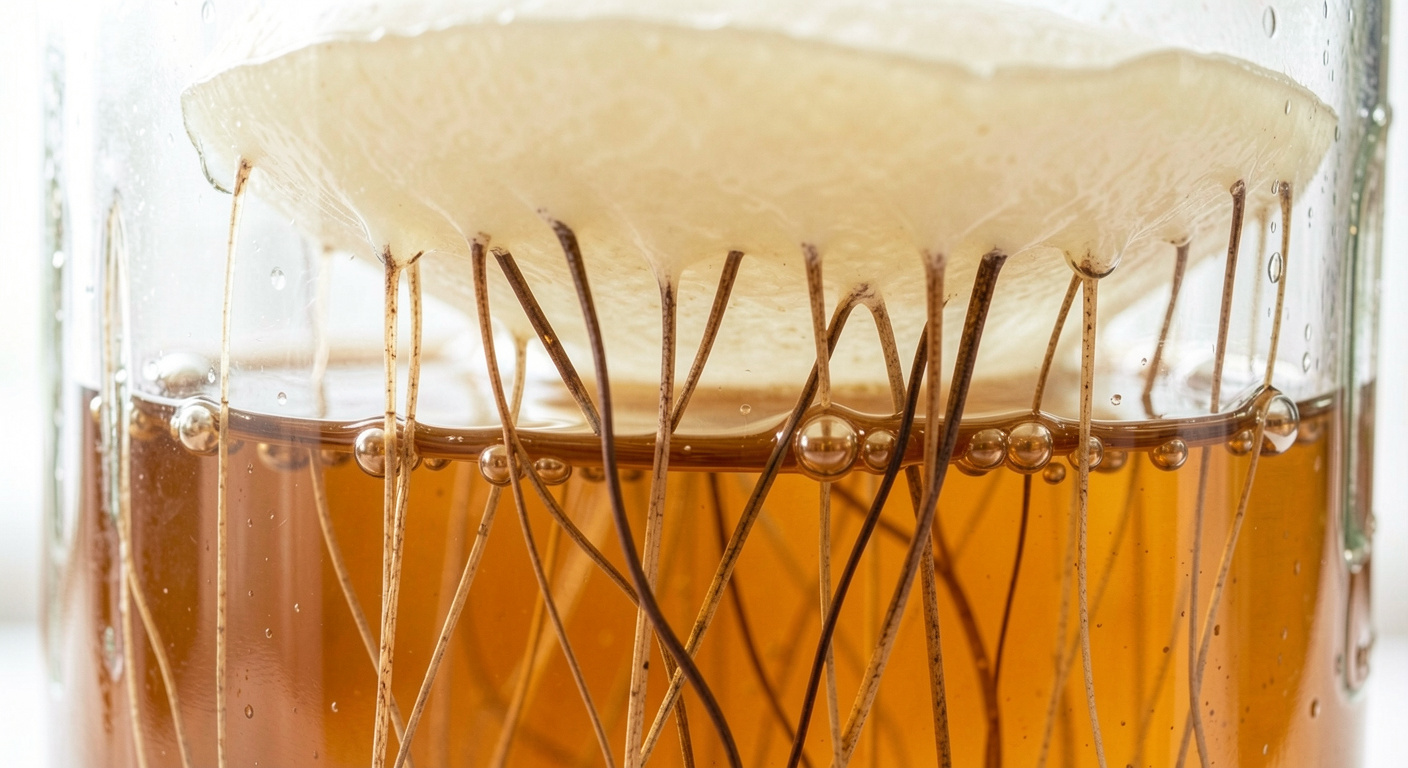
- Location is the first diagnostic: Mold grows exclusively on the surface of the liquid or SCOBY; yeast lives submerged, hanging in strands beneath the culture [4].
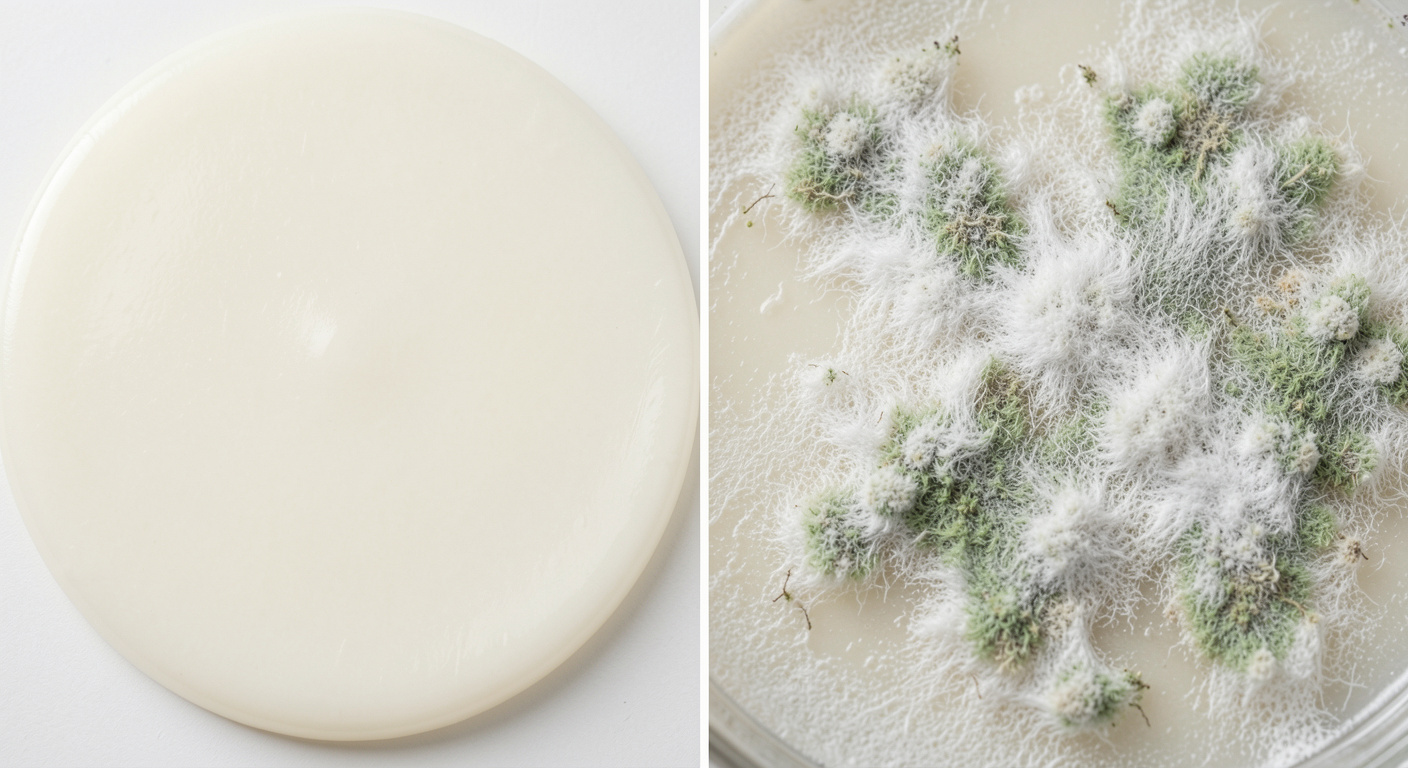
- Texture tells the story: Real mold is dry, fuzzy, or powdery to the eye. Yeast formations are slimy, gelatinous, or stringy — never fluffy [5].
- Color matters, but not alone: Mold can be white, green, black, blue, or even red. Yeast strands are brown, tan, or muddy — sometimes clumpy but never brightly colored [5].
- The genera to know: Home-brewed kombucha is most susceptible to contamination by Penicillium and Aspergillus species, both of which grow on the SCOBY surface [1].
- Mycotoxin risk is real: Some Aspergillus strains can produce mycotoxins, making genuine mold a genuine food-safety concern — not just an aesthetic issue [1].
- Prevention beats diagnosis: Sufficient starter tea, sanitary equipment, and proper brew temperatures are the three pillars that keep mold away from your vessel [6].
| Signal | Mold (Discard) | Yeast (Safe) |
|---|---|---|
| Location | On the surface / top of liquid | Submerged beneath SCOBY |
| Texture | Fuzzy, powdery, dry | Stringy, slimy, gelatinous |
| Color | White, green, black, blue, red | Brown, tan, muddy |
| Smell | Musty, earthy, off | Vinegary, yeasty, normal |
| Behavior | Spreads and grows over days | Stable, may shift with brew temp |
| Risk | Possible mycotoxins — discard batch | None — natural part of fermentation |
TL;DR: Brown stringy stuff hanging below your SCOBY is almost always yeast and is completely normal; fuzzy, colored growth on the surface is mold and warrants discarding the entire batch.
Understanding What's Actually Living in Your Kombucha Vessel
Before you can tell the bad guys apart from the good guys, it helps to understand what a healthy fermentation vessel looks like at a microbial level.
The SCOBY Is Already a Mold-Fighting Machine
Kombucha's primary defense against contamination is its acidity. During first fermentation (F1), the symbiotic culture of bacteria and yeast (SCOBY) converts tea sugars into organic acids — primarily acetic acid and gluconic acid — dropping the brew's pH well below 4.0. Most mold species cannot thrive at these pH levels, which is why a healthy, well-acidified batch is largely self-protecting [2].
The brown stringy material you'll see hanging beneath the SCOBY pellet or growing in clouds at the bottom of the jar is yeast. These are the same yeast organisms responsible for producing the CO₂ and alcohol that drive fermentation. According to Kombucha Kamp, one of the most-referenced kombucha communities online, "yeast strands are brown and sometimes clumpy, but when underneath the surface can never be mold." [4] Strands of yeast can also embed in the new SCOBY layer as it forms, creating brown streaks or patches within the culture itself — entirely normal and not a cause for concern [4].
Why Mold Can Still Appear Despite Acidity
Even a healthy brew can develop surface mold under certain conditions: too little starter liquid, equipment that wasn't fully sanitized, fruit or botanical additions that carried in wild spores, or brew temperatures that dropped too low, slowing the acidification process [6]. A 2025 peer-reviewed review published in the journal Foods confirmed that "home-brewed kombucha poses a higher risk of contamination compared to commercially produced" kombucha, largely because of inconsistent temperature control and sanitation [3].
Fermentation temperature has a measurable effect: research cited in the Jayabalan et al. comprehensive review of kombucha tea microbiology found that mold growth and potential mycotoxin contamination were studied at temperatures of 17°C, 22°C, and 25°C under home-brewed conditions, with lower fermentation temperatures correlating with higher mold risk due to slower acidification [8].
The Genus-Level Threat: Penicillium, Aspergillus, and Why They Matter
The molds most commonly reported in home-brewed kombucha belong to two genera:
- Penicillium: Typically presents as blue-green fuzzy growth, familiar from bread and citrus mold. It thrives on the nutrient-rich, slightly warm surface of a fresh brew [1].
- Aspergillus: Can present in white, green, or black, and is the more serious of the two. The British Columbia Centre for Disease Control (BCCDC) notes in its food safety guidance that "some toxin-producing Aspergillus species could be of concern" in home kombucha brewing, specifically because of their capacity to produce mycotoxins — toxic secondary metabolites that are harmful to human health [1].
A third genus, Botrytis (the gray mold familiar to gardeners), is occasionally referenced in fermentation contamination literature, though it is less commonly documented in kombucha specifically. The key takeaway: any surface mold on your brew deserves to be taken seriously, regardless of genus, because the potential for mycotoxin production makes tasting your way to a diagnosis a bad idea [2].
"Cases of contamination with Aspergillus and Penicillium species have been reported. Some of the molds can be associated with the production of mycotoxins, which may present health hazards." — Foods (MDPI), peer-reviewed review on kombucha safety, 2025 [3]
The Visual Diagnostic: A Step-by-Step Identification Framework
The moment you notice something unusual in your vessel, run through this quick decision tree before touching anything.
Step 1 — Check the Location First
This is the single most reliable rule in kombucha troubleshooting, and it comes directly from experienced brewing communities and food safety educators alike:
- Below the liquid surface? It is physically very difficult for mold to grow submerged in an acidic liquid environment. If whatever you're looking at is hanging underneath the SCOBY or floating mid-liquid, it is almost certainly yeast [4][7].
- On the surface of the liquid or SCOBY? This is where mold lives. Surface exposure to air, plus reduced acidity at the liquid-air interface, creates the only environment where mold spores can take hold [5].
When in doubt, gently tilt the jar or use a clean spoon to see if the growth is rooted on the surface or suspended beneath it. Surface growth stays put; yeast strands will drift and move.
Step 2 — Evaluate Texture and Structure
Once you've established location, assess texture:
| What You See | What It Likely Is | Action |
|---|---|---|
| Fuzzy, dry, powder-like spots | Mold (Penicillium, Aspergillus) | Discard entire batch |
| Smooth, wet, gelatinous layer | New SCOBY pellicle forming | Leave it alone |
| Brown strings hanging below | Yeast strands | Completely normal |
| Brown blobs or clumps at bottom | Yeast accumulation | Normal |
| Cloudy sediment at bottom | Yeast and SCOBY particles | Normal |
| Brightly colored surface patches | Mold (various species) | Discard entire batch |
As You Brew Kombucha explains: "Mold can be white, green, black, blue, red — if you're seeing interesting bright colors, that's a bad sign." [5] By contrast, healthy kombucha cultures are white-to-cream or progressively browner with age, and new SCOBY growth, while sometimes alarmingly thin or uneven-looking, has a smooth, wet sheen rather than a dry fuzz.
Step 3 — Use Your Nose as a Secondary Check
A healthy batch smells tangy, yeasty, and vinegary — sometimes sharply so, depending on fermentation age. Mold introduces a distinctly musty, earthy, or off smell that is difficult to miss once you know what you're sniffing for. If the smell seems wrong and you see suspicious surface growth, trust both signals together. However, smell alone is not sufficient to declare a batch safe: a moldy brew can sometimes smell relatively normal in the early stages of contamination [6].
What Happens When It Really Is Mold: Next Steps
If you've worked through the checklist above and you're confident you're looking at surface mold — fuzzy, dry, and colored — the decision from a food safety standpoint is unambiguous.
Discard Everything — SCOBY Included
This is the hard truth that every experienced brewer will tell you: when genuine mold is confirmed, you must discard the entire batch and the SCOBY. Mold mycelium penetrates deeper than the visible surface growth suggests, and attempting to scrape off the mold and salvage either the liquid or the culture risks consuming mycotoxins that are invisible to the eye [6]. The Foods peer-reviewed review is direct on this point: some mold species associated with kombucha contamination "can be associated with the production of mycotoxins, which may present health hazards." [3]
"It can come in different colors, such as white, green, blue, or black… SCOBY mold is a pesky type of mold that enjoys making itself at home on the surface of the kombucha culture." — Cultures for Health, fermentation education resource [6]
Do not:
- Taste the liquid to see if it "seems okay"
- Scrape the mold off and continue fermenting
- Use a SCOBY from a moldy batch to start a new one
- Save the starter liquid from a confirmed mold batch
Sanitize Before You Restart
After discarding a moldy batch, clean your fermentation vessel and any equipment (cloth covers, rubber bands, spoons) thoroughly. Mold spores can linger on surfaces and seed your next batch if not addressed. A rinse with distilled white vinegar after washing is a low-tech but effective step. If your vessel is glass, a brief rinse with a sanitizing solution (Star San or similar, rinsed out) provides additional insurance.
Starting your next batch with a healthy SCOBY from a trusted source and at least 10–20% starter liquid by volume (some brewers use up to 2 cups per gallon) is the most important preventive step you can take [6]. Check out the complete home kombucha brewing guide from F1 to F2 for a full breakdown of starter liquid ratios and temperature guidelines that minimize contamination risk.
Preventing Mold Before It Starts: The Brewer's Checklist
The three most reliable defenses against mold in home kombucha are acidity, sanitation, and temperature — and they work synergistically.
Acidity: Your First Line of Defense
Starter liquid — previously brewed, well-fermented kombucha — lowers the pH of your fresh sweet tea before mold spores can establish themselves. The target is to get your new batch below pH 4.0 as quickly as possible. Using too little starter liquid is the single most common cause of mold in new brewer batches [6].
Practical guidelines:
- Use at least 1–2 cups of mature kombucha per gallon of sweet tea
- Never use store-bought kombucha that has been diluted or flavored as your sole starter
- If you're starting from a dehydrated SCOBY, add extra starter liquid and brew in smaller batches initially
- Use pH strips or a pH meter to confirm your batch is acidifying on schedule — aiming for below 3.5 by day 3–4 at typical room temperature
For guidance on tracking your fermentation schedule and pH progression, KombuVault's batch-tracking tools let you log readings over time and flag if your batch isn't acidifying at the expected rate.
Temperature: Mold's Window of Opportunity
Fermentation temperature directly affects the speed of acidification. Cooler temperatures slow the bacteria-and-yeast culture's metabolism, giving mold spores more time to establish on the surface before the brew acidifies enough to fight back. Research has documented mold growth being evaluated at temperatures as low as 17°C (63°F) in home-brewed conditions [8].
Optimal brew temperature range: 75–85°F (24–29°C). Below 70°F, your batch acidifies slowly enough to create a mold risk window, especially in the first 48–72 hours. Above 85°F, the culture can become overly dominated by acetic acid bacteria, producing an overly vinegary batch — a separate but common problem that affects flavor (see our flat kombucha and carbonation troubleshooting guide for related F2 issues).
Sanitation: Closing the Spore Entry Points
Mold spores enter your brew through contaminated equipment, unwashed hands, improperly cleaned vessels, or botanical add-ins (fresh fruit, herbs, flowers) that carry their own wild microbial load. A practical sanitation protocol:
- Wash all equipment with hot, soapy water and rinse thoroughly
- Rinse with distilled white vinegar to lower surface pH before use
- Use tightly woven cloth (not cheesecloth) or a coffee filter secured with a rubber band to cover the vessel — this keeps fruit flies and airborne spores out while allowing gas exchange
- Wash hands before handling the SCOBY or touching the inside of the vessel
- Inspect add-ins: fresh fruit and botanicals are higher risk — consider using fruit juice or freeze-dried fruit powders in F2 instead of raw fruit chunks in F1
For more on safe F2 flavoring techniques that minimize contamination, browse our 10 creative second fermentation flavor recipes — all designed with sanitation and safety in mind.
Brewing kombucha at home is a rewarding practice with a learning curve, and the mold-vs.-yeast panic is a rite of passage for almost every home brewer. When you can quickly tell the difference — brown stringy below the surface versus fuzzy colored growth on top — you'll brew with far more confidence and far fewer wasted batches. KombuVault is built specifically to support home brewers at every step of this journey: log your F1 and F2 temperatures and pH readings, get reminders for bottling day, browse and share flavor recipes with the community, and tap into a troubleshooting resource that helps you make the call before you pour anything down the drain. Your SCOBY deserves a second opinion — and now you know how to give it one.
Frequently asked questions
Can yeast strands in kombucha look like mold?▾
Yes, especially to new brewers. Brown, stringy, or clumpy material in your kombucha can look alarming, but if it is submerged beneath the SCOBY or hanging down into the liquid, it is almost certainly yeast — a normal and essential part of fermentation. Mold cannot survive submerged in acidic kombucha and always grows on the surface of the liquid, where it has access to air.
What does mold on kombucha actually look like?▾
Kombucha mold is dry, fuzzy, and powdery, and appears on the surface of the liquid or the top of the SCOBY. It can be white, green, black, blue, or even red. If it looks like the mold you'd see on bread or citrus fruit — that texture and color — treat it as confirmed mold. A smooth, wet, or gelatinous surface is normal new SCOBY growth, not mold.
Is it safe to drink kombucha with white stuff in it?▾
If the white substance is below the surface, stringy, or gelatinous, it is almost certainly yeast or a developing SCOBY pellicle and is safe. If the white substance is fuzzy, powdery, and sitting on the surface, it may be mold — particularly Penicillium or Aspergillus — and you should discard the entire batch without tasting it, as some mold species can produce mycotoxins.
Can I save a kombucha batch that has mold on it?▾
No. Food safety experts and experienced brewing communities agree: if you confirm real surface mold (fuzzy, dry, colored growth), you should discard both the liquid and the SCOBY. Mold mycelium penetrates deeper than the visible surface suggests, and scraping off visible mold does not eliminate the risk of mycotoxin contamination in the remaining liquid.
What causes mold in home-brewed kombucha?▾
The most common causes are: insufficient starter liquid (not enough acidity to protect the fresh batch), low fermentation temperatures that slow acidification and give mold time to establish, unsanitized equipment or vessels, and contamination introduced through fresh fruit or botanicals. Using at least 1–2 cups of mature kombucha per gallon and maintaining a brew temperature of 75–85°F significantly reduces mold risk.
How do I prevent mold from coming back in future batches?▾
Use generous amounts of starter liquid (at least 10–20% of total volume), maintain fermentation temperature between 75–85°F, sanitize all equipment thoroughly before each brew, cover your vessel with a tightly woven cloth (not cheesecloth) to exclude fruit flies and airborne spores, and wash hands before handling the SCOBY. Starting with a healthy, active SCOBY from a trusted source is also critical.
Sources
- Kombucha Tea Food Safety Guidance — BC Centre for Disease Control
- Kombucha: Microbiology, Composition, Fermentation, Beneficial Effects, Toxicity — PMC 2025
- Kombucha Tea Safety and Microbiology Review — MDPI Foods 2025
- Kombucha Mold Information and Pictures — Kombucha Kamp
- Mold on Kombucha: What It Looks Like and What to Do — You Brew Kombucha
- SCOBY Mold on Kombucha: What It Is and How to Prevent It — Cultures for Health
- Is My Kombucha Moldy? Mold vs Not Mold — Grow Create Sip
- A Review on Kombucha Tea — Microbiology, Composition, Fermentation, Beneficial Effects, Toxicity, and Tea Fungus — Jayabalan et al. 2014, Comprehensive Reviews in Food Science and Food Safety
Keep reading
Ready to brew a batch worth sharing?
Get KombuVault free →